On the night of July 17, 2026, Zach Steen didn't sleep. He owns Graveyard Point Icehouse and Austin Paddleboard & Kayak, and for hours he kept walking down to check his dock on Lake Travis, moving it in a little farther every time the water climbed. "I was up all night last night, just moving our dock in every few hours, trying to be as prepared as possible, having that checklist of what needs to be taken care of," he told KXAN. "With all the debris that is in the lake right now, we're going to pause at least for the next 5 or 7 days, kind of wait and see what LCRA says. We're going to play it safe."
By the next evening, the lake had done something it hadn't done in seven years. It reached full pool at 681 feet above mean sea level, and kept climbing into the weekend as the Lower Colorado River Authority opened floodgates at Mansfield Dam for the first time since 2019. As of today, Lake Travis sits at 99.7 percent of conservation capacity.
For anyone marketing waterfront property right now, that number reads like perfect timing. Docks float. Ramps work. Sometimes Island, the sandbar that only surfaces in low years, is back underwater. But a full lake answers the question a listing photo wants answered. It doesn't answer the one a buyer actually needs answered, which is what happens to that same dock the next time the lake drops sixty feet, because it has done exactly that, more than once, inside a single decade.
The Rise Everyone Is Talking About
For most of the last seven years, Lake Travis sat well below full, exposing sandbars, drying out boat ramps, and leaving Sometimes Island visible more often than it wasn't. Then, over one Thursday-to-Friday stretch in mid-July, the lake rose roughly ten feet after repeated rounds of heavy Hill Country rain, pushing past its 681-foot threshold and into its flood pool, which Axios Austin reported climbed a few feet higher still by that Sunday.
It's genuinely good news for anyone with a boat this month. It's also exactly the moment when the lake's actual job, storing and releasing water for a million-plus people downstream, gets obscured by how good the shoreline looks in August.
What Full Pool Actually Buys You Right Now
The 681-foot line isn't a marketing threshold. It's an engineering one. John Hofmann, executive vice president of the LCRA, explained it plainly when the lake crossed that mark:
"We are full for water supply purposes at elevation 681. Above 681, that's where our designated flood pool resides at Lake Travis."
That distinction matters more than it sounds like it should. The lake isn't "full" because it's pretty. It's full because a state-chartered river authority manages it to a specific elevation for water supply and flood control, and everything a waterfront buyer sees on a showing, the depth under the dock, the ramp that finally works again, the view without a mudflat in it, is downstream of that management decision.
The Mechanism the Full Lake Doesn't Show You
Lake Travis has a documented history of swinging more than sixty feet between full pool and drought lows. During the severe 2011 to 2015 drought, the lake fell to roughly 618 feet, more than sixty feet below full, and waterfront values dropped somewhere between 25 and 40 percent from their pre-drought peaks. Lakefront sales on the south shore fell to around 22 units in one of the worst years and took until roughly 2016 to climb back toward 50. Analyses of past cycles have generally found that every six-foot drop in lake level shaves roughly 3.5 percent off waterfront property values, and full recovery after a serious drought has typically taken two to four years, faster for homes with deep-water access and slower for anything shallow and fixed.
The seven-year stretch that just ended followed the same pattern. It wasn't a malfunction. It's how a flood-control reservoir is designed to behave. The LCRA holds water for downstream supply and releases it according to rainfall and drought stage, not according to what's showing well on a Saturday tour.
What Separates a Resilient Dock From a Stranded One
Not every lot on Lake Travis carries the same exposure to the next dry cycle, and the differences are specific enough to check before you write an offer, not after.
| Lot Feature | Historically More Resilient | Historically More Exposed |
|---|---|---|
| Position on the lake | Open water, main lake body | Protected cove |
| Dock construction | Floating dock system | Fixed pier on posts |
| Permit status | Current LCRA permit on file | Older grandfathered permit |
| Backup access | Walking or boating distance to a marina | No marina within reach |
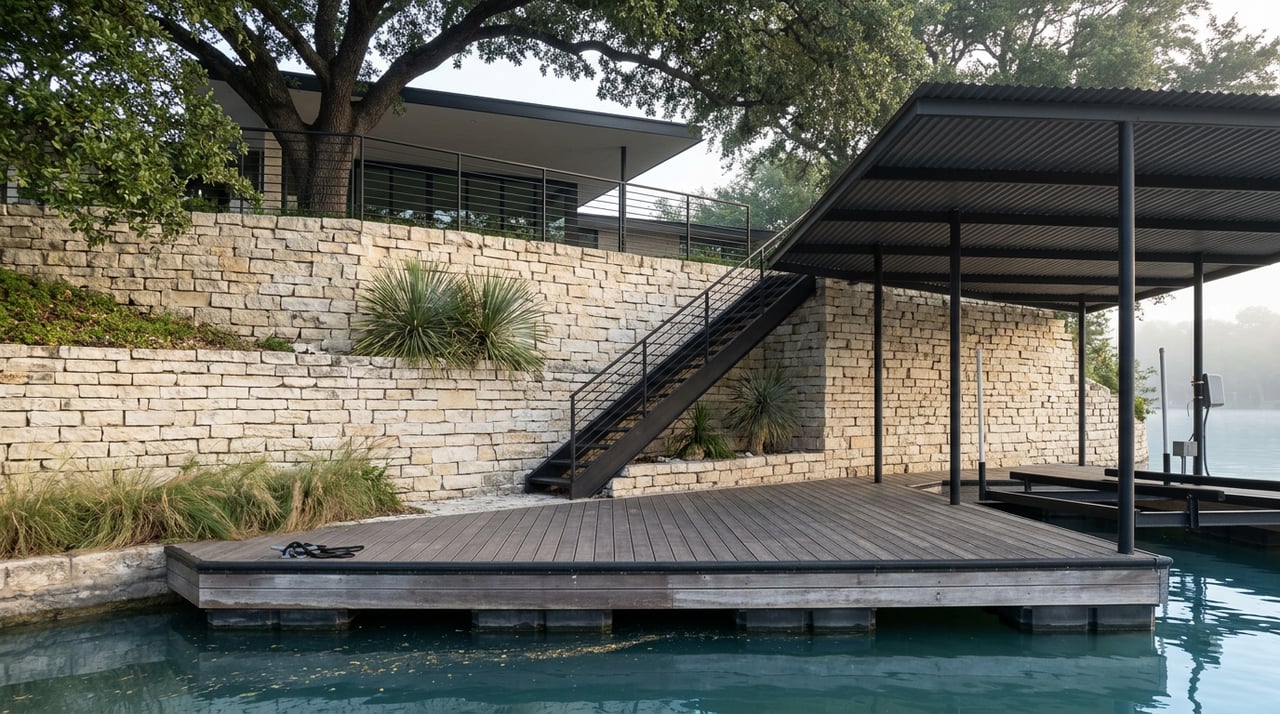
Coves lose depth faster than the main lake body during a drawdown, sometimes turning into mudflats while open-water frontage still holds usable depth. Floating docks rise and fall with the lake, while fixed piers can end up stranded well above the water line. Permit history matters more than most buyers expect, too. Some older docks carry grandfathered permit conditions that don't allow the same structure to be rebuilt at the same size if it's ever destroyed, which means the dock in the listing photos isn't necessarily the dock you're entitled to replace.
Three Questions Worth Asking Before You Write an Offer
- What did this specific dock look like in 2015? Pull the historical lake-level chart from the LCRA or Water Data for Texas and check the parcel's elevation against it directly, not against how the property shows today.
- Is the dock floating or fixed, and is the permit current? Ask for the actual LCRA permit documentation as part of due diligence, not just an appraisal that assumes the structure as-is.
- What's the fallback if the private dock goes dry? Proximity to a public marina, such as Lakeway Marina, Emerald Point, or Volente Beach, keeps a property usable for boating even when a private slip temporarily isn't.
Why the Same Lake Cuts Differently Depending on Where You Are
Lake Austin, a few miles east, doesn't carry this risk in the same way. It's held at a constant level by a downstream dam rather than managed as flood storage, so it doesn't swing the way Lake Travis does. Dock permits there are notoriously hard to obtain, which pushes entry prices higher, but a permitted Lake Austin dock isn't going to sit twenty feet above dry ground during the next drought. Lake Travis trades that certainty for scale: more shoreline, a wider range of price points, and a broader buyer pool, precisely because the water moves.
That tradeoff is showing up in two different signals in Lakeway right now. Broader home-value measures for the market have softened somewhat over the past year, while waterfront listings tied directly to marina access and lake frontage are getting fresh attention off the July refill. Reading a single median price tells you neither story. You have to separate the aggregate market from the water-dependent slice of it.
For investors, the swing has a monetization side too. A well-managed waterfront home on Lake Travis can gross well into six figures a year in short-term rental income during peak boating season, which is exactly why the dock-specific homework above carries more weight here than in most other Austin-area submarkets. That income only holds up as long as the dock does, and having personally underwritten properties through a full drought-to-refill cycle changes how closely you read that number before recommending it to a client.
FAQ
How do I check Lake Travis's current water level before making an offer? The LCRA and Water Data for Texas both publish free, real-time lake-level data along with historical charts going back decades at waterdatafortexas.org. Pull the ten-year chart for the specific parcel's location before you write terms, not after you're under contract.
Does every dock on Lake Travis need a permit? No. The LCRA does not require a permit, registration, or fee for residential docks of 1,500 square feet or smaller, though all docks must still meet the agency's safety standards for flotation, lighting, anchoring, and distance from shore. Larger docks and any marina facility do require a permit.
If you're weighing a waterfront lot on Lake Travis, or comparing it against Lakeway's golf-course communities or Lake Austin's constant-level shoreline, the dock is rarely the least important line item, even though it's often the last thing a buyer asks about. Kinan Beck, One Source Team has spent years buying, holding, and advising on Central Texas waterfront property through both the dry years and the full ones, and knows exactly which questions to run down before an offer goes in. Schedule Your Austin Consultation to talk through a specific parcel's water history before you write one.