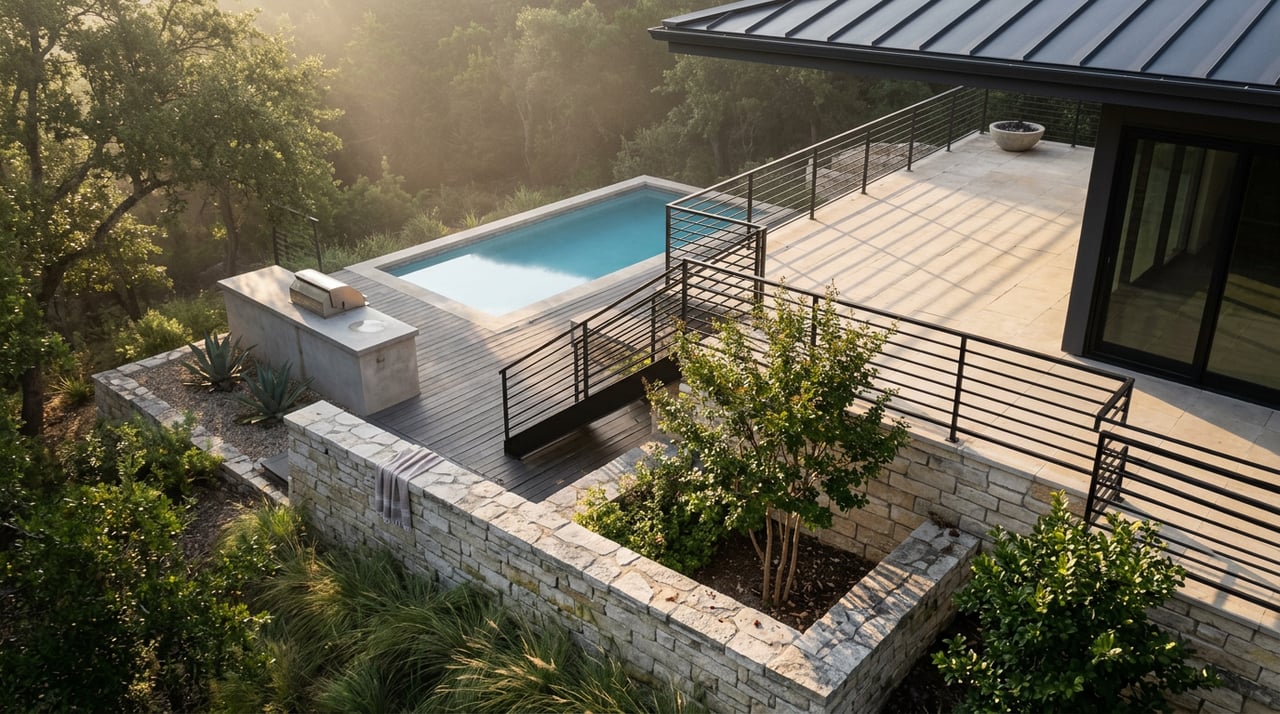
"As it is, I have a fifth of sky view from my living room."
That line came from a homeowner at Lakeway's February 17, 2026 city council meeting, one of twenty residents who signed up to speak that night. Every one of them opposed loosening a rule they believed had locked in their lake view since 2011. Their fear was specific: repeal the ordinance, and a neighbor's new build or addition could climb high enough to erase the sliver of Lake Travis they bought their house to see.
Here is what almost none of them said out loud, and what the city's own staff report quietly contradicts. The ordinance they were defending has rarely stopped anyone from building. If you are comparing a home in Old Lakeway to something in Rough Hollow, Flintrock Falls, or The Hills, the difference between "protected view" and "view, for now" matters more than the listing photos suggest, and the rule that draws that line is being rewritten as you read this.
What the VPCO Actually Regulates
The View Protection Conditional Overlay, or VPCO, has applied to a mapped section of Lakeway since 2011, with earlier building-height provisions dating back to 1996. It covers Old Lakeway, described in city planning documents as the area largely north of Lakeway Boulevard, encompassing roughly 3,500 residential lots. That is a specific, mapped boundary. It does not apply to every home in the city, and it does not apply automatically just because a listing says "lake view."
What the ordinance actually does, according to the city's own staff report, is narrower than most buyers assume:
- It stacks on top of base zoning and only restricts height, nothing else about the structure or lot use.
- No home in the district can exceed 32 feet under any circumstance, VPCO or not.
- New construction and additions go through separate review processes, and the zoning commission evaluates potential view impacts case by case.
- Even when a project is flagged, the commission cannot stop the development outright. It can only require a height adjustment.
That last point is the one worth sitting with. A rule that can trim a roofline but cannot block a build is a very different asset than a guarantee that your view stays intact.
The Number That Undercuts the Fear
Here is where the staff report becomes genuinely useful to anyone shopping in Old Lakeway. City staff reviewed the ordinance's actual track record and found that only 3.9 percent of cases reviewed under the VPCO resulted in a real view-blocking determination. The other 96 percent went through without the commission finding that a project unreasonably obstructed a neighbor's established view.
Read that against the testimony from February. Residents described the ordinance as foundational to their property values and their sense of security. In practice, the process it created has almost never been the thing standing between a homeowner and a blocked view. Most projects that go through VPCO review simply clear it. The rule functions less like a wall and more like a formality that occasionally slows a project down, and City Manager Joseph Molis told the council directly that the internal issues with the ordinance make it hard to answer basic questions about how it is derived and enforced.
None of this means the VPCO is worthless. A homeowner who wants to add a second story and finds their plans capped at 32 feet, or nudged down a few feet after a neighbor's objection, has experienced exactly what the ordinance is built to do. It just is not the blanket view guarantee that gets referenced in listing copy or defended at the podium.
Why the Rulebook Is Changing Under Your Feet
This dispute did not start as an abstract zoning debate. It started with a homeowner rebuilding after a fire who wanted to raise the roofline by 1.5 feet, paired with a separate resident's request that the city require neighbors to trim trees blocking established views. Those two requests, filed around the same time, pushed staff to take a hard look at an ordinance they already knew was difficult to administer.
The Zoning and Planning Commission voted 6-1 on February 4, 2026 against repealing the VPCO outright, and instead recommended the city fix its inconsistencies rather than scrap it. At the February 17 council meeting, that recommendation turned into a decision to form a subcommittee. On March 16, 2026, the council passed Resolution 2026-03-16-01, formally creating the VPCO Committee: seven residents, two zoning commissioners, and two council members, tasked with defining what a protected view actually means and making the ordinance more objective and enforceable. That committee reports back to council on a quarterly basis, and as of this writing it has not finished its work.
Mayor Tom Kilgore, the lone dissenting vote on keeping the old ordinance in place while the rewrite happens, has argued the current rule is constitutionally shaky because it tries to protect a private view of a public lake, comparing it unfavorably to Austin's ordinance protecting public sightlines of the Capitol from Congress Avenue. City staff have separately acknowledged that the map defining where the VPCO applies is inconsistent and that residents are often confused about what the rule actually protects, sometimes assuming it keeps their neighbor's lot free of development entirely rather than simply capping height. Whatever the committee lands on will likely reshape both the boundary map and the standard used to judge future projects.
What This Means If You're Comparing Lakeway to Other Waterfront Options
If you are weighing an Old Lakeway home against something in a different section of the city or a different Lake Travis community altogether, three things are worth doing before you get attached to a view in the listing photos.
First, confirm the specific lot sits inside the mapped VPCO district. The boundary is defined as running largely north of Lakeway Boulevard, but the city itself has said the map has inconsistencies, so a call to Building and Development Services to confirm a parcel's status is worth the ten minutes it takes.
Second, understand that "protected" in this context has historically meant a 3.9 percent chance of an enforceable outcome, not a guarantee. If a seller or their agent describes a lot as having a protected view, ask what that protection would actually prevent a neighbor from building, because the honest answer is: a structure over 32 feet, and not much else in the vast majority of cases.
Third, factor in the timeline. The committee working on this is still active, and nobody outside that room knows yet whether the rewrite will tighten enforcement, loosen it, redraw the map, or replace the whole framework with something new. Buying into Old Lakeway right now means buying into a rule in transition, not a settled one.
FAQ
Does the VPCO apply to every home in Lakeway? No. It applies only within the mapped overlay district, described by the city as the area largely north of Lakeway Boulevard, covering approximately 3,500 residential lots in what residents call Old Lakeway. Homes in other Lakeway communities are governed by base zoning without this additional height overlay.
Does the ordinance guarantee my view will never be blocked? Not in practice. The ordinance can require a project to reduce its height if the zoning commission finds an unreasonable obstruction, but it cannot stop development on a neighboring lot altogether, and the city's own review found that only 3.9 percent of cases resulted in an actual view-blocking determination.
What happens if the ordinance is repealed instead of revised? As of the council's March 2026 action, repeal is off the table for now. The council chose to form a committee to rewrite the ordinance rather than eliminate it, and the current rule stays in effect until that rewrite is finished and adopted.
When will the new version take effect? There is no set date. The committee created in March 2026 reports to council quarterly, and as of this writing the process is ongoing.
If you are weighing a home in Old Lakeway against another Lake Travis community, or trying to figure out what a "view lot" is actually worth once you understand how thin that protection can be, Kinan Beck, One Source Team can walk the specific parcel with you before you write an offer. Schedule Your Austin Consultation and get a straight read on what you are actually buying.