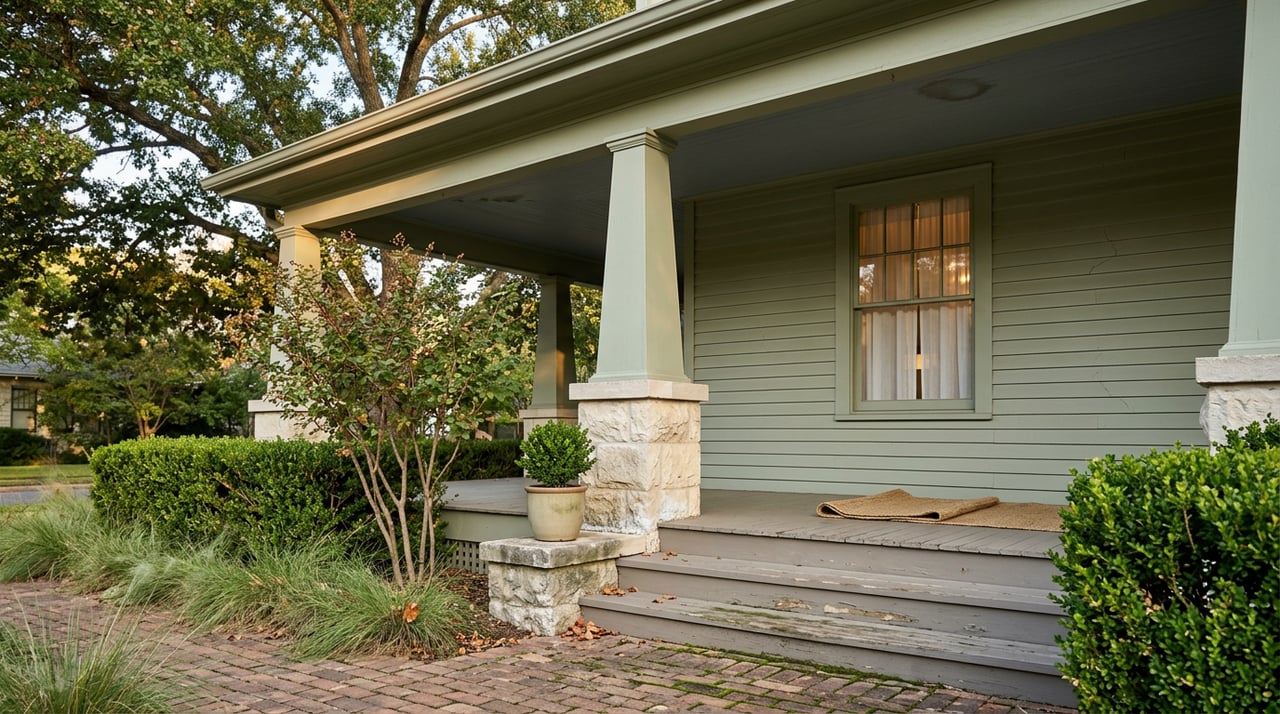
Ask anyone outside the neighborhood what a Saturday in Travis Heights looks like and they'll describe South Congress: the shops, the "I love you so much" sign at Jo's Coffee, a slow crawl past the vintage racks. That's the version tourists get, and it's not wrong. It's just backward. Ask someone who actually lives on the bluffs above Lady Bird Lake, and the day starts somewhere South Congress can't see: a heated pool tucked into a neighborhood park, a mile of shaded trail most visitors never find, and a new restaurant that opened this summer without a single mention on the corridor everyone assumes is the whole neighborhood.
The geography explains the habit. Travis Heights isn't built around a commercial strip the way people picture it. It's built around a loop, and the loop starts at a pool that never closes for winter.
The Pool That Doesn't Know It's August
Big Stacy Park anchors the south end of the neighborhood, and its spring-fed pool is heated and stays open year-round. That single fact reshapes how residents use August differently than a visitor would expect. Nobody's racing the calendar here. The pool that's packed on a 100-degree Saturday in August is the same pool locals use in December when the rest of the city has put its swimsuits away.
Just north, Little Stacy Park does the opposite job. Its wading pool, playgrounds, and picnic pavilion make it the family stop, the place with tennis and basketball courts where the trail actually begins. Together the two parks form bookends, and what connects them is the part of the loop nobody markets.
A Mile That Connects Two Parks Nobody Advertises
The Blunn Creek Greenbelt Trail runs about one mile between Little Stacy and Big Stacy, and it's short enough that most guides skip it entirely in favor of longer, more photogenic hikes elsewhere in Austin. That's a mistake if you actually live here. The trail crosses Blunn Creek on a bridge with lines more than one reviewer has compared to Frank Lloyd Wright, tunnels under a second bridge, and passes beneath one of the city's remaining Moon Towers at East Side Drive and Leland Street.
If a mile isn't enough, the trail connects to something rougher. Blunn Creek Nature Preserve sits just across the street from St. Edward's University, forty acres that feel nothing like the manicured park system a few blocks away. The preserve climbs toward a Volcano Overlook, a nod to the volcanic ash that gives sections of the ground their odd gravel texture, and the steeper stretches near the top are enough to notice in your legs on the walk back down.
This is the part of Travis Heights that never shows up in a South Congress guide, because it isn't retail. It's topography, and it's the reason longtime residents describe the neighborhood as feeling smaller and quieter than its address a mile from downtown would suggest.
What Changed on the Loop This Summer
The loop isn't static. In June, The Well opened its fourth Austin location in Bouldin Creek, co-owned by Nicole and Rich Pfromm, in a 3,000-square-foot building with 85 interior seats and a 24-person private dining room. The menu is built around ingredients the restaurant states are free of gluten, dairy, seed oils, soy, refined sugar, and GMOs, which is a specific enough claim that it's worth knowing before you show up expecting a standard brunch menu. Breakfast tacos use pasture-raised eggs, and the lunch menu runs through Thai lettuce wraps and a coconut curry squash built on locally grown produce.
What's notable isn't just that a new restaurant opened. It's where. Bouldin Creek doesn't get restaurant openings the way South Congress does, so when one lands here, it's a signal that the loop itself is drawing enough daily foot traffic to support a full-service kitchen a few blocks off the main corridor. Residents who've watched this stretch for years will recognize that as a shift worth noticing, not a footnote.
The Loop Ends Where Everyone Assumes It Starts
South Congress still matters. It's just the last stop, not the first. On Saturdays, the SoCo Select Farmers & Makers Market sets up at South Congress and Monroe from 11 a.m. to 5 p.m., weather permitting, under the oak trees on that corner. Vendors sell handmade jewelry, pottery, and vintage clothing, and it functions less like a farmers market and more like a weekly gathering point for people who live within walking distance.
From there, the corridor does what it's always done: Jo's Coffee, the mural, the shops. It's the version of Travis Heights that photographs well and gets shared online, and there's nothing wrong with ending a loop there. The point is that it's an ending, not the whole story. The neighborhood's actual daily rhythm runs from a heated pool, through a mile of shaded trail past a Moon Tower, past a restaurant that only opened seven weeks ago, and only then into the corridor everyone assumes is the destination.
If you're piecing this together for a Saturday, the order that matches how the neighborhood actually uses itself looks something like this:
- Morning laps or a slow float at Big Stacy Pool, before the heat sets in
- The mile-long Blunn Creek Greenbelt walk north to Little Stacy, past the bridge and the Moon Tower
- A detour into Blunn Creek Nature Preserve if you want the climb to the Volcano Overlook
- Lunch at The Well in Bouldin Creek, or a stop for whatever's new along the way
- The SoCo Select Market, if it's Saturday and you're there before 5 p.m.
- Coffee at Jo's to close it out, South Congress last
None of this requires a car. That's the part outsiders underestimate about Travis Heights: the compression. A pool, a trail, a preserve, a new restaurant, a market, and a coffee shop with a mural people fly in to photograph all sit within a walk that most cities would spread across three separate zip codes. Here, it's one loop, and it explains why people who've lived on these streets for twenty years still describe the neighborhood as feeling like a small town, even with downtown visible from the ridge.
That compression is also why the neighborhood rewards attention. A restaurant that opens in Bouldin Creek instead of on the main strip isn't hiding. It's betting that the loop itself brings enough people past the door. So far, that bet is paying off.
If you're already living this loop and curious what it means for your own address, or you're weighing a move into Travis Heights and want someone who actually walks these blocks to talk through it, Kinan Beck and the One Source Team are a call away. Schedule Your Austin Consultation whenever you're ready to talk specifics.